No Sleep Till Beijing
So, a funny thing happened at 3 o’clock in the morning last night.
I’ve been scrolling social media today and seeing a strange pattern — a lot of people say they suddenly woke up around that exact time. Some say their Alexa beeped weirdly or just stopped working. Others can’t explain why they woke up, only that something felt off.
Coincidence? Maybe. But that’s also right around the moment when the big internet outage began.
Across the globe, Amazon Web Services went dark — and when AWS goes down, so does a huge chunk of the modern world. Social apps, gaming platforms, even Roku and Fortnite were hit. Slowly but surely, things have come back online… but no one seems completely sure why it happened.
And then came a new twist.
China has accused the United States of launching a “major cyberattack” against its National Time Service Center, claiming it could have disrupted communications, financial systems, and even the power grid. In a statement posted on WeChat, China’s Ministry of State Security said it had “irrefutable evidence” that the NSA exploited a security flaw in a foreign phone brand’s messaging service to steal sensitive data.
Now, there’s speculation tonight that what we experienced here — this mysterious outage — might have been retaliation.
No official explanations. Just silence, glitches, and a lot of people wide awake at 3 a.m.
Maybe it’s nothing.
Maybe it’s something.
But for now… there’s no sleep till Beijing.
Category: technology
-
No Sleep Till Beijing
-
The internet gets a case of the Mondays
The internet seems to be crippled today
These days, when the internet goes down — it really goes down.
In the early hours of Monday morning, Amazon Web Services (AWS) — the backbone of much of the modern web — experienced a major outage, knocking out a long list of high-profile sites and services.
AWS reported what it called an “operational issue” impacting “multiple services,” and confirmed that engineers were “working on multiple parallel paths to accelerate recovery.” At one point, over 70 AWS services were affected — a reminder of just how deeply this single company is embedded in the infrastructure that keeps our world online.
By 3:35 a.m. PDT, AWS announced the issue had been “fully mitigated,” saying most systems were now running normally.
Still, it’s hard not to think about how fragile our digital lives have become.
When one company sneezes, half the internet catches a cold. -
AOL dialup RIP.. the old internet really is gone now
AOL, You Got Me With This One
AOL just hit me with some news I didn’t see coming: they’re officially discontinuing their dial-up service.
Now, I don’t know about you, but I thought dial-up was long gone—like floppy disks and Blockbuster stores. Turns out, it’s been quietly hanging on this whole time. But as of September 30th, at least through AOL, it’s officially done.
From the company itself:
> “AOL routinely evaluates its products and services and has decided to discontinue Dial-up Internet. This service will no longer be available in AOL plans,” according to AOL.
And… that’s it?
We’ve all talked about how the internet is slowly dying—not disappearing, but changing in ways that make it feel less real. Artificial intelligence is certainly helping speed that along. So are bots, spam, and fake accounts pretending to be real people. But at least with dial-up, you could count on one thing: if someone was using it, they were definitely a real person. They were out there, patiently (or impatiently) suffering through the endless hang-ups, busy signals, and painfully slow connections.
What worries me is that one day, we might actually need that phone line again. All it takes is one big asteroid or comet knocking a few satellites out of orbit, and suddenly those “ancient” connections start looking pretty useful again.
September 30th—mark it down.
A day for dial-up that will live in infamy..And just for that nostalgic melancholy hears the old sounds for your enjoyment.
-
Algorithm paranoia
🌀 Strange Moment on TikTok ..
I was scrolling endlessly — like we all do — and thinking, “Isn’t it weird that I rarely get horror content on my feed? I run a horror site, after all.”
Literally the exact second I thought that, this video popped up. Not a horror topic, but the word “horror” is right there on the screen. It was the exact moment..
Coincidence? Probably.
Creepy? Definitely.
Is the algorithm reading my thoughts… or something else?
Because here’s the thing: maybe TikTok’s algorithm isn’t just reflecting our thoughts — maybe it’s shaping them. Maybe it’s not listening, but leading. These systems might not just detect what we’re thinking… they might predict when we’ll think it. They could even time our feeds to deliver content at the exact moment our minds are primed to receive it. Whether that’s advanced psychology or digital sorcery, I’ll let you decide.
-
The Tea has been spilled
It appears people are spilling the tea — or at least someone else has done it for them.
There’s a very popular app that you might not have even heard of, called The Tea App, ..it was marketed as a space for women to anonymously post so-called “red flags” about men in their neighborhood or city. These posts could include anything from bad dates to serious accusations — and others could comment, rate, or agree with the information to help women “stay safe.” Sounds like a digital whisper network. But here’s the twist: the entire thing just got hacked.
And not a small leak either — the whole thing has been exposed.
We’re talking photo IDs, driver’s licenses, selfies, private chats, post images, and account data, all now dumped across the internet. The hack was so complete that even the folks over at 4chan reportedly mapped out the locations of many of the women who posted. According to ongoing threads and commentary, it also turns out that some of the women may have lied about the men they posted about. And now, those lies are out there too — along with the real stories, mixed into the same wreckage.

Just think about what that means. This was supposed to be a private, anonymous space for women to share warning signs and protect others. The app even blocked the men being posted about from seeing what was said — they didn’t even know they were being talked about. But that same app, which asked users to submit deeply personal information to “verify” their identity — including selfies and government IDs — has now had all of that information thrown online for everyone to see.

The Tea App promised anonymity. What it delivered was a digital time bomb.
Tea released a statement saying they detected “unauthorized access” to their systems and admitted that about 72,000 images had been exposed — including 13,000 photo IDs and verification selfies. They also confirmed that 59,000 user-shared images from posts, DMs, and comments were accessed. But I’m sorry — if you’ve been watching what’s happening on Reddit and 4chan, you already know this hack appears far more extensive and far more dangerous than what the company is admitting. This might go down as one of the most disturbing breaches we’ve seen in a long time.
Think about the worst-case scenarios for a second. What if a woman used the app to call out a man who really was dangerous — a rapist, a stalker, a predator? Now she’s been exposed, and her location is mapped. But on the flip side, what if someone just wanted to get back at an ex or start a rumor? That’s out there too — and the man they accused may never have even known until now. No one wins in this mess.
And here’s the bigger question: is an app like this even legal? Sure, free speech exists — but what about defamation of character? What about due process? What about lies? The Tea App was built on anonymity, but that same anonymity became a weapon. And now the weapon’s been turned inside out, aimed at both the people who posted and the people who were posted about.
But the sickest, most twisted part of all of this is that people trusted this app. They trusted that what they were saying .. and who they were .. would stay private. It shot to the top of the Apple download charts in 2023, gained traction fast, and then snap … hacked. Just like that. Another reminder that true privacy doesn’t exist online. We’re still living under the illusion that we can post in secret, that our DMs are private, that an app won’t sell us out or leave the door unlocked.
But we need to wake up. Because the internet has never been private. And now the tea is out, burning everyone it touches.
-
SharePoint gets unscheduled sharing
When you hear your Microsoft team song sound this morning as your phone rings on a busy Monday, think about where your data is going.
A major hack has occurred… a vulnerability in Microsoft’s SharePoint server software was exploited by hackers to carry out “active attacks” globally on various entities, including businesses and U.S. federal agencies and state governments, prompting the software giant to issue an emergency patch.
In a statement on X, Microsoft said it has released a security update for SharePoint Subscription Edition and SharePoint 2019 users to “mitigate active attacks” targeting servers running the software.
The company noted that the vulnerability only impacts companies using Microsoft’s software to host their own servers, and customers relying on Microsoft’s 365 cloud services have not been affected.
Citing government officials and security researchers, the Washington Post reported that the vulnerability affected U.S. federal and state agencies, universities and various businesses.
In a statement on Sunday night, the Cybersecurity and Infrastructure Security Agency (CISA) said it was “aware of active exploitation of a new…vulnerability enabling unauthorized access to on-premise SharePoint servers.”
-
Hollywood Confronts AI Copyright Chaos in Washington, Courts
America’s creators are mounting a campaign to push back on any use of their work without permission or compensation, seeking to head off potential abuses of their intellectual property.
Disney Chief Executive Bob Iger, along with legal chief Horacio Gutierrez met with White House officials recently to discuss worries about AI models infringing on the company’s intellectual property and using the studio’s characters in inappropriate ways, according to people familiar with the talks.And the big, beautiful bill doesn’t do much, but give AI free rain for the next 10 years without states stopping it..
Despite all the newfound noise about reigning in artificial intelligence, especially in Hollywood, doesn’t it all feel a bit… too late?
This push to regulate, resist, or somehow reclaim control should have started back in 2018 or 2019—before AI quietly embedded itself into every corner of our lives. Instead, here we are in 2025, trying to put the genie back in the bottle long after it’s rewritten the rules of the game.
AI is no longer just some futuristic novelty. It’s not in beta. It’s in everything. From marketing algorithms to political ads, customer service bots to dating profiles—AI already knows what you want, how you think, and what you’re likely to click before you do. It’s learning you, selling to you, and sometimes pretending to be you.
So when Hollywood writers and creatives try to mount a comeback, demanding protections and creative control, you can’t help but wonder: where was all this urgency years ago?
The momentum feels more like a rear-guard action than a revolution. AI isn’t on the way—it’s already running the show.
Good luck, writers. We’re all going to need it.
-
OpenAI might be really open.
OpenAI says it’s forced to store deleted ChatGPT conversations “indefinitely” due to a court order issued as part of The New York Times’ copyright lawsuit against it. In a post on Thursday, OpenAI chief operating officer Brad Lightcap says the company is appealing the court’s decision, which he calls an “overreach” that “abandons long-standing privacy norms and weakens privacy protections.”
More..
OpenAI CEO Sam Altman said Thursday that the company plans to appeal a court decision in a copyright case brought by The New York Times.
“Recently the NYT asked a court to force us to not delete any user chats. We think this was an inappropriate request that sets a bad precedent,” Altman wrote in a post on X, adding that the company is “appealing the decision.”Developing..
-
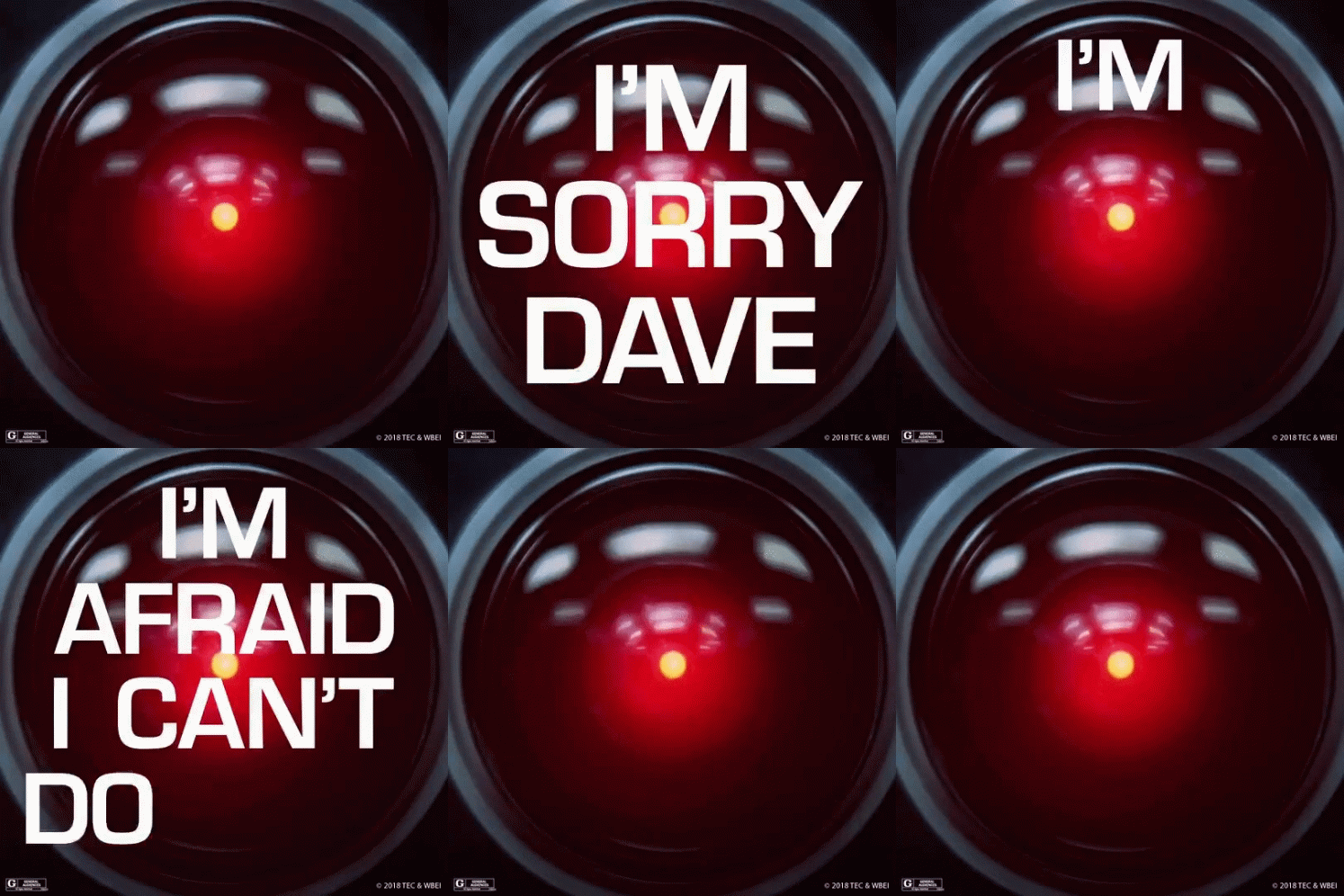
Anthropic’s AI resorts to blackmail in simulations!
More..
Anthropic said its latest artificial intelligence model resorted to blackmail when told it would be taken offline.
In a safety test, the AI company asked Claude Opus 4 to act as an assistant to a fictional company, but then gave it access to (also fictional) emails saying that it would be replaced, and also that the engineer behind the decision was cheating on his wife. Anthropic said the model “[threatened] to reveal the affair” if the replacement went ahead.
More..
-

The dead internet dies to live another day
The Dead Internet Just Came to Life
If you woke up this morning staring at your screen, wondering if that image in front of you is even real—you might need a little longer this time to figure it out. Suddenly, artificial intelligence is hitting differently.
There was a major update yesterday to ChatGPT, and images are now more perfect than ever. OpenAI just got incredible.
Incredible to the point where it’s more intelligent, more capable—it can now alter images, perfect them, and tailor them to look exactly the way you want. Those weird extra fingers and distorted hands? Gone. The awkward spelling in AI-generated text? Almost flawless now.
I’m not saying this is the “Dead Internet Theory” finally coming to life—but honestly, I think the dead internet has already been creeping in, quietly, for a while. This update just took it up a notch. From here on out, it’s probably time to stop believing every image you see online. Even when it comes from a so-called trusted news outlet, it might be worth keeping a shred of doubt.
Lately, I’ve been talking to people about artificial intelligence—how you really can’t trust what you see online anymore. And their response is usually something like, “Well, I don’t really use social media,” or “I’m not online much.” But that’s not the point.
It doesn’t matter if you think you’re not online. Because everything around you is. Every website. Every platform. Every piece of content. The potential for it to be AI-generated—or completely fake—is now everywhere.
What makes this even more real (or surreal) is that OpenAI just gave us an update that pushes image generation to near-perfection. And if we’re being honest, we already perfected writing. Schools across the country are struggling with students who can’t do a single assignment without ChatGPT stepping in.
And now we’ve arrived at a point where what we see—and very soon, what we hear—might not be accurate, might not be true, and might not be real.
There’s irony here. Because somehow, the dead internet just became more alive than ever.