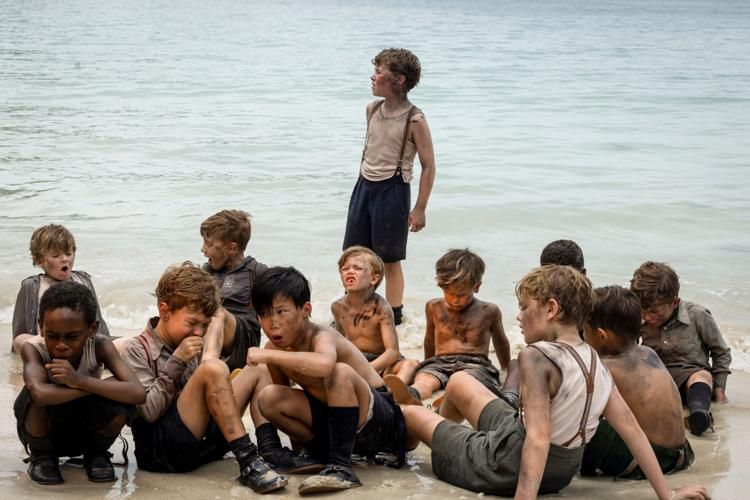
Lord of the Flies has been required reading for generations of high school students. At some point along the way, its popularity may have faded in classrooms, but the story itself never really went anywhere. If anything, it may be more relevant now than it was when it was first handed out as an assignment.
A recent example of that kind of storytelling connecting again came with Adolescence, a British series that quietly became one of the most talked-about shows on Netflix. It centered around a boy who committed unspeakable acts, and instead of focusing on spectacle, it focused on the aftermath… the family… the uncomfortable reality of it all. It was thought-provoking, difficult, and important.
And that brings things right back to Lord of the Flies.
For those who have read the book, nothing about this new adaptation is going to feel shocking.
The foundation is already known… a group of boys stranded, structure breaking down, power struggles forming, and something darker taking hold. What is new, however, is the way this story is being presented in 2026.
The latest adaptation of Lord of the Flies arrives as a four-episode limited series, marking the first time the story has been fully explored in a television format.
The series was written by Jack Thorne and directed by Marc Munden, with each episode focusing on a different central character—Ralph, Piggy, Jack, and Simon.
The cast is made up largely of unknown young actors, which gives the entire thing a more grounded and unsettling feel.
The series is adapted by Jack Thorne, the writer behind the stage play “Harry Potter and the Cursed Child” and the Emmy-winning TV series “Adolescence,” and directed by his longtime collaborator, Marc Munden.
“A lot of the time it was utter chaos and we tried to film some of that chaos as well,” says Munden. “It can’t help but be chaos when you’ve got 36 boys under the age of 12.”
Thorne’s four-part adaptation brings a different character to the forefront in each episode, starting with the rational Piggy, coming to consciousness after the crash and offering a voting-based system that allows everyone a voice. “What we need to do is get a sense of exactly what we know,” he says
This wasn’t originally a Netflix production.
The series actually premiered in the United Kingdom on the BBC One and its streaming platform BBC iPlayer back on February 8, 2026. It also found a home in other international markets before eventually landing in the United States. What’s being seen now is the result of Netflix acquiring the U.S. streaming rights, which is why it suddenly appeared as if it just debuted—when in reality, it’s already been out there for a few months.
So yes… it did already come out.
Just not here.
Now that it’s on Netflix, reactions are starting to split in a way that’s almost more interesting than the show itself.
Some reviewers are calling it a descent into horror, a slow-burn unraveling of humanity under pressure. But what’s becoming clear is that the reactions to the show might be more chaotic than the show itself.
The top critics—the paid reviewers—are loving it. Scores are sitting comfortably in the 90% range.
But the general audience?
That’s a different story.

At the time of this writing, only about 55% of viewers are landing on the positive side of things. The divide is real. It’s one of those rare cases where the “official” opinion and the “power to the people” opinion are going in completely different directions.
So the question becomes…
Which side is right?
That’s something that will have to be decided after watching it firsthand. And honestly, that might be the most interesting part of all of this. Not just whether the show works—but whether it works for everyone, or only for the people who are paid to say that it does.