Tag: space

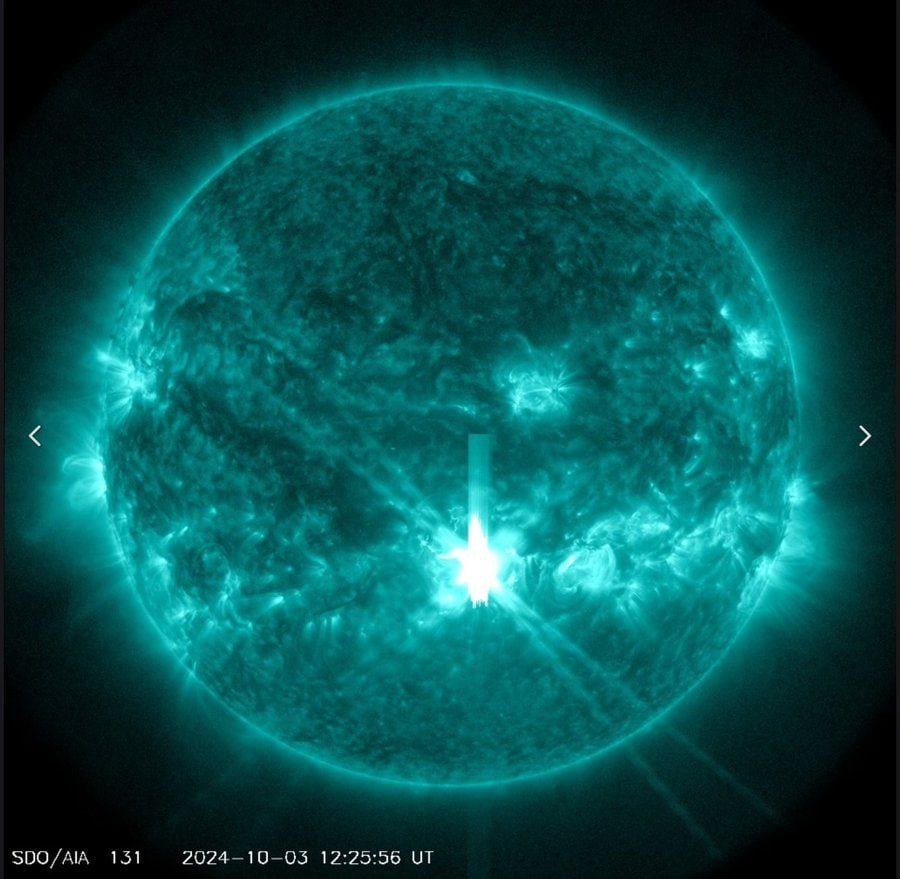
  • A dead heat!! Solar flare direct shot!

    A dead heat!! Solar flare direct shot!

    This one could affect satellites and GPS and all the other typical things that get affected..

    From solar ham:

    A coronal mass ejection (CME) with a halo signature is evident following the major X9.0 solar flare this morning. Because the source region AR 3842 is directly facing Earth, the plasma cloud appears to be aimed directly towards our planet. A further update will be provided later today once a CME tracking model becomes available. Please note that a faint CME associated with the X7 event on October 1st is expected to pass our planet sometime during the next few days. Aurora sky watchers at middle to high latitudes should have their camera batteries charged up should geomagnetic storming be observed as forecast.

    SolarHam.com

    And at this point, it appears to be the largest solar flare, since at least 2017.
  • Moonfall: Autumn of the mini moon

    Moonfall: Autumn of the mini moon

    Get ready for this bingo card moment..

    Moonfall!

    Earth will get a second moon for about two months this year when a small asteroid begins to orbit our planet. The asteroid was discovered in August and is set to become a mini-moon, revolving around Earth in a horseshoe shape from Sept. 29 to Nov. 25.

    Researchers at the Asteroid Terrestrial-impact Last Alert System, an asteroid monitoring system funded by NASA, spotted the asteroid using an instrument in Sutherland, South Africa and labeled it 2024 PT5. 

    But all thus hubub.. and you probably won’t even be able to see it..

    The study’s lead author Carlos de la Fuente Marcos told Space.com the mini-moon will be too small to see with amateur telescopes or binoculars but professional astronomers with stronger tools will be able to spot it..

  • A meteor may have shaken parts of New York City and New jersey

    A meteor may have shaken parts of New York City and New jersey

    Residents in parts of New York City and New Jersey were shaken by a loud boom Tuesday July 16 morning.. NASA officials saying it was likely due to a daylight fireball meteor.

    NASA’s Meteor Watch team reports that the daylight fireball was seen at 11:17 a.m. ET, according to an update shared to Facebook Tuesday afternoon..

    A daylight fireball is a meteor that is bright enough to be visible during daylight hours because it’s burning brighter than the sun’s light as it enters the Earth’s atmosphere…

    Developing..

  • NASA predicts an asteroid has a 72 percent chance of hitting Earth in 2038

    NASA predicts an asteroid has a 72 percent chance of hitting Earth in 2038

    https://www.the-express.com/news/space-news/141313/nasa-asteroid-collision-exercise-earth-space

    In a hypothetical scenario posed to a group of nearly 100 government representatives, NASA found that their plan to combat the asteroid hurtling towards Earth had several “high-level gaps,” according to their presentation.

    They said space officials have “limited readiness to quickly implement needed space missions,” and methods to keep the public informed on the impending disaster are not fully developed.

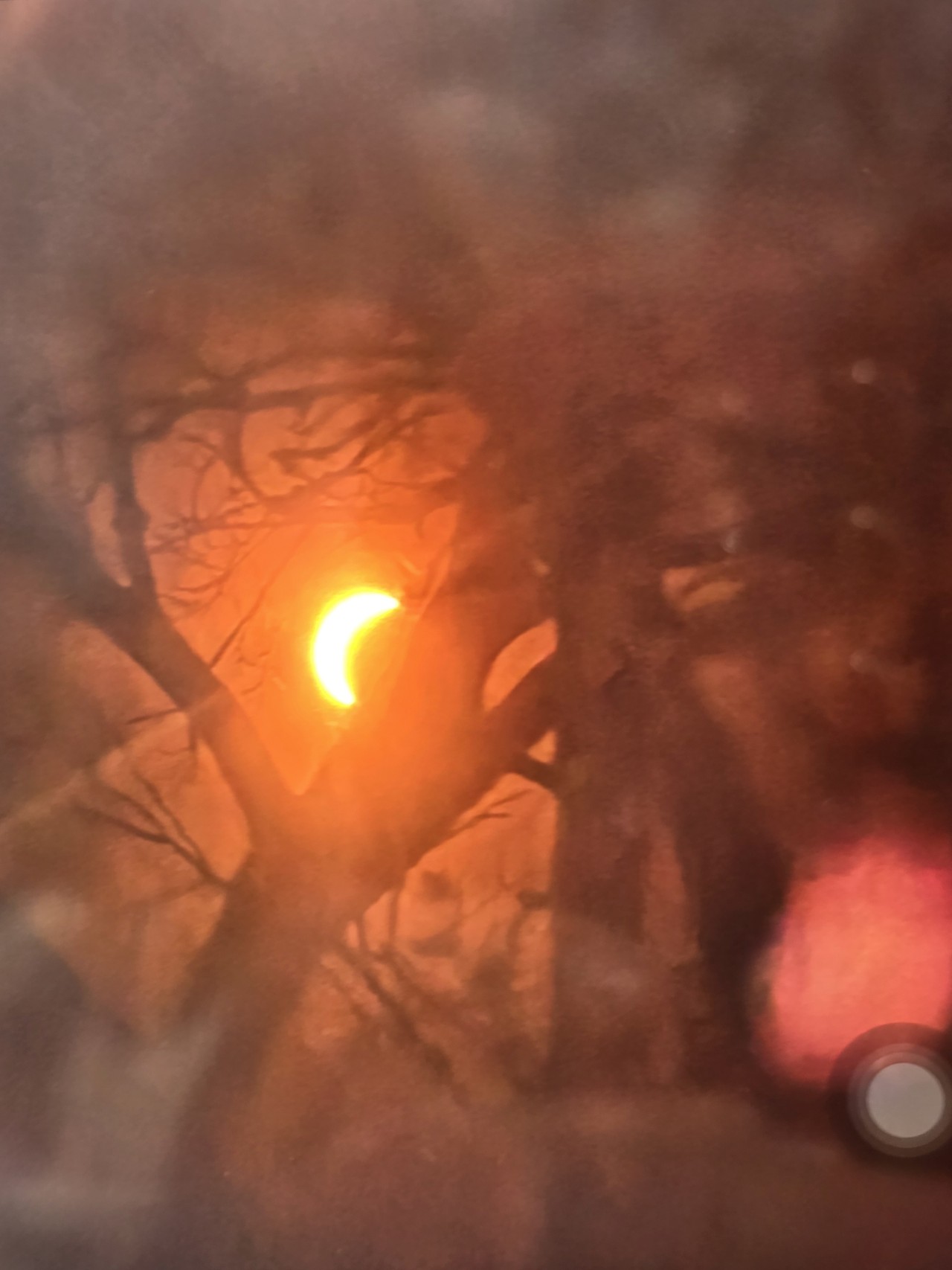
  • Staring at the sun in reverence: The 2024 solar eclipse

    Staring at the sun in reverence: The 2024 solar eclipse

    When the sun vanished behind the mighty tiny moon there was a reverence and silence that seemingly came over the crowd..

    Animals acted..off.. everything grew dim with long shadows and a dull faint light.

    While not totality, it was cooler and calmer than what I experienced in 2017..

    When the sun began coming back with light everyone breathed more of a relief than they expected to..

    The mighty sun rose again. The heat and safety returned ..

    It sure makes sense how worshipping the sun became a thing.

    image
    image
    image
    image
    image
    image
    image
    image

    While no massive earth quakes or end times hit us, there were some oddities. Like this:

    But this very real and intense moment on ABC news captures it all: The excitement.. the animals reacting.. the silence. the reverence.. the darkness.. The deep seated ancestral fear of darkness.. And the return of the light:

    @abcworldnews

    “It is really, truly breathtaking here in Burlington, Vermont.” @ABC News anchors David Muir and Linsey Davis were in Burlington, Vermont, as the #EclipseAcrossAmerica made its way across the country. They witnessed the solar eclipse, and the sun’s diamond ring after totality ended. @ABC News Live @Good Morning America @National Geographic

    ♬ original sound – ABC World News Tonight

    So that’s a wrap!! See you in Florida in 2045!! If I’m alive.. my son may give it a shot in 2079 when he’s 68..

    Until then.. what a show!

  • Another satellite expected fo fall to earth this week

    Another satellite expected fo fall to earth this week

    “A European Space Agency satellite is expected to reenter and largely burn up in Earth’s atmosphere on Wednesday morning. The agency’s Space Debris Office, along with an international surveillance network, is monitoring and tracking the Earth-observing ERS-2 satellite, which is predicted to make its reentry at 6:14 a.m. ET Wednesday, with a 15-hour window of uncertainty.

    The ESA is also providing live updates on its website. “As the spacecraft’s reentry is ‘natural’, without the possibility to perform manoeuvers, it is impossible to know exactly where and when it will reenter the atmosphere and begin to burn up,” according to a statement from the agency.”

    https://www.cnn.com/2024/02/19/world/ers-2-european-space-agency-satellite-reentry-scn/index.html#:~:text=A%20European%20Space,from%20the%20agency.

  • JAMES WEBB RUMORS: Don’t count on them too much

    JAMES WEBB RUMORS: Don’t count on them too much

    Rumors Circulating That James Webb Has Discovered Life on Another World

    No, But… Ars Technica reports that the persistent rumor that the James Webb Space Telescope has found a planet with strong signs of life h

    YAHOO NEWS

    Rumors sure.. but it is more than likely that NASA will not Admit to such—though it just seems entirely impossible that earth is the only inhabitable planet in the universe.. that aside, Futurism reports this:

    Though a NASA official told Ars that no “definitive evidence” has been found so far, they acknowledged the possibility of a huge discovery on the horizon that — sorry, folks — would take years worth of followup research to confirm.

    “It is anticipated that JWST observations may lead to the initial identification of potential biosignatures that could make habitability more or less likely for a given exoplanet,” Knicole Colón, the James Webb’s deputy project scientist for exoplanet science, told Ars. “Future missions will be needed to conclusively establish the habitability of an exoplanet.”

    It’s an answer worded to tamp down any out-of-control rumors, but it certainly leaves the door open to some exciting possibilities — a no, but “not a hard no,” in Ars’ analysis.

    So keep looking to the stars..

  • Asteroid may hit the Earth in 159 years

    Asteroid may hit the Earth in 159 years

    Don’t let the headline scare you. Everyone reading this will be dead when this event occurs 159 years from now..

    NASA predicts large asteroid impact could be in Earth’s future(WTAJ) — NASA scientists are predicting a chance that asteroid Bennu will strike Earth in the future, potentially affecting an area the size WTAJ – WWW.WTAJ.COM 

    But your kids kids may not be..

    NASA scientists are predicting a chance that asteroid Bennu will strike Earth in the future, potentially affecting an area the size of Texas.

    Bennu is a Near-Earth Object (NEO) that passes by the planet roughly every six years and experts have been watching it since it was discovered in September 1999.

    According to scientists, Bennu has an extremely small chance to pass through what they call a “gravity keyhole” which would send it on a collision course with Earth in the year 2182.

  • Rumors: NASA Is About To Make A Big Announcement On Unidentified Anomalous Phenomena

    Rumors: NASA Is About To Make A Big Announcement On Unidentified Anomalous Phenomena

    All eyes on Thursday mornings live stream for whatever this means.. and whatever it will be..

    Developing..

    The announcement is scheduled for 10:00 EDT on Thursday, September 14, at NASA’s headquarters in Washington DC. The public can watch a live stream of the briefing, which will be led by an independent study group commissioned by NASA in 2022.

    The study group, consisting of 16 experts in the fields of science, aeronautics, and data analysis, is spearheaded by astrophysicist David Spergel. According to NASA, the objective of the study is to “examine UAP from a scientific perspective and create a roadmap for how to use data and the tools of science to move our understanding of UAP forward.”
    — Read on blog.physics-astronomy.com/2023/09/breaking-nasa-is-about-to-make-big.html

  • Signs of life on a distant planet 120 light years from Earth

    Signs of life on a distant planet 120 light years from Earth

    CNN:

    Waters may be flowing on the surface of a colossal planet that lies about 120 light-years from Earth, according to new evidence uncovered by the James Webb Space Telescope.

    The investigation with the space-based observatory, one of the most advanced astronomy instruments in operation, revealed that the exoplanet K2-18b may have some key features of a planet that could support bodies of water — and life.

    Closely orbiting the cool dwarf star K2-18, the exoplanet lies within the star’s habitable, or Goldilocks, zone and is 8.6 times as massive as Earth. An analysis of Webb’s observations found the planet has abundant methane and carbon dioxide in its atmosphere.

    The presence of these carbon-bearing molecules, along with a scarcity of ammonia, could indicate an atmosphere rich with hydrogen that surrounds an ocean world, according to a NASA news release.

    Carbon is considered the building block of life-forms on Earth.

    The Hubble Space Telescope initially spotted evidence of water vapor in the exoplanet’s atmosphere. The finding, described in a September 2019 study, helped scientists home in on K2-18b for further study.

    The Webb telescope, which can detect infrared light invisible to the human eye, searched for exactly what elements are featured in the planet’s atmosphere.

    And the latest observations of the planet also hint that a very special molecule, called dimethyl sulfide, could be present on K2-18b.

    DEVELOPING..