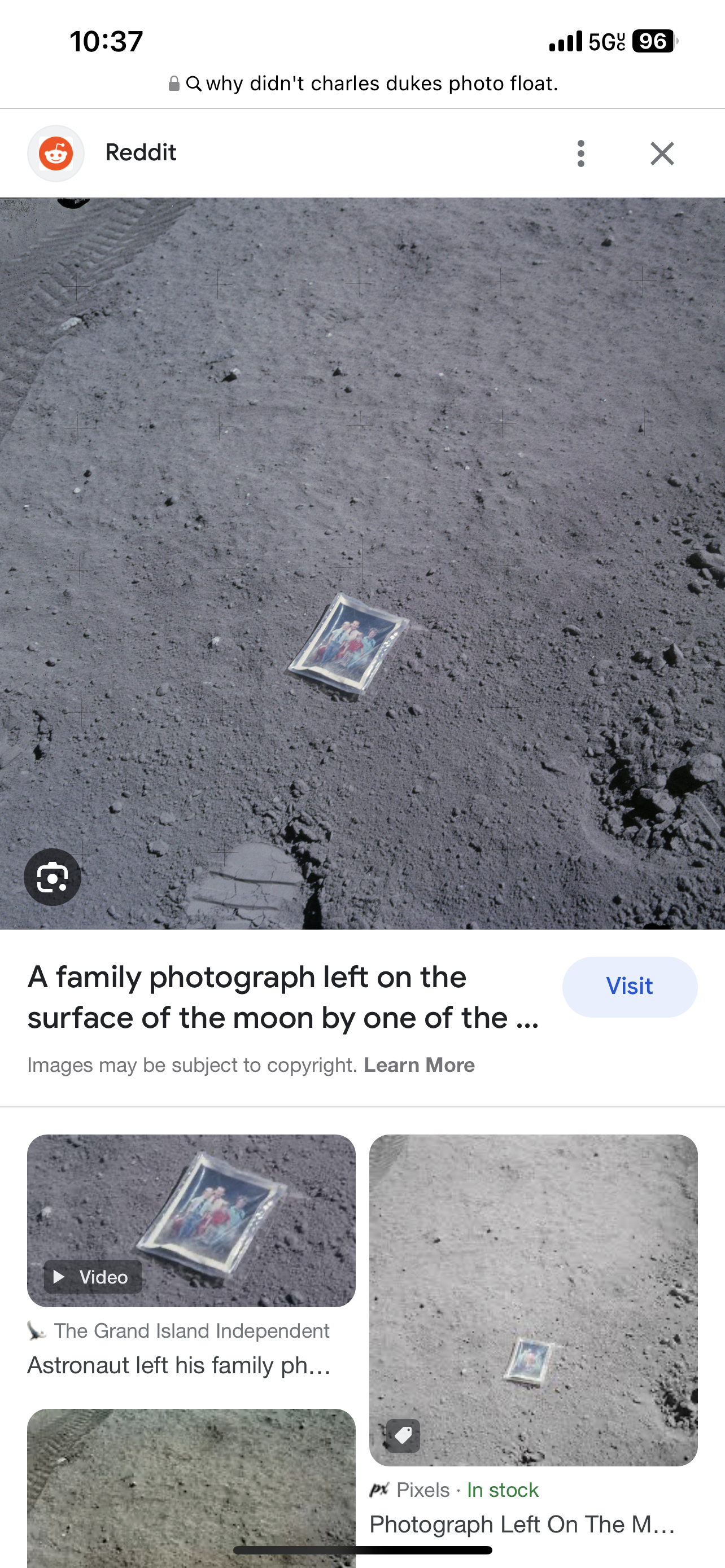
Of all the videos we see of astronauts they slowly float in the low gravity moon atmosphere… why is this securely planted on the ground and not floating..
Now of course when something hits the moon surface, it stays right? It won’t float anymore even if light.. but it would be interesting to see video of the photo being placed down. Was it dropped or held down to ‘attach’ itself to the surface?
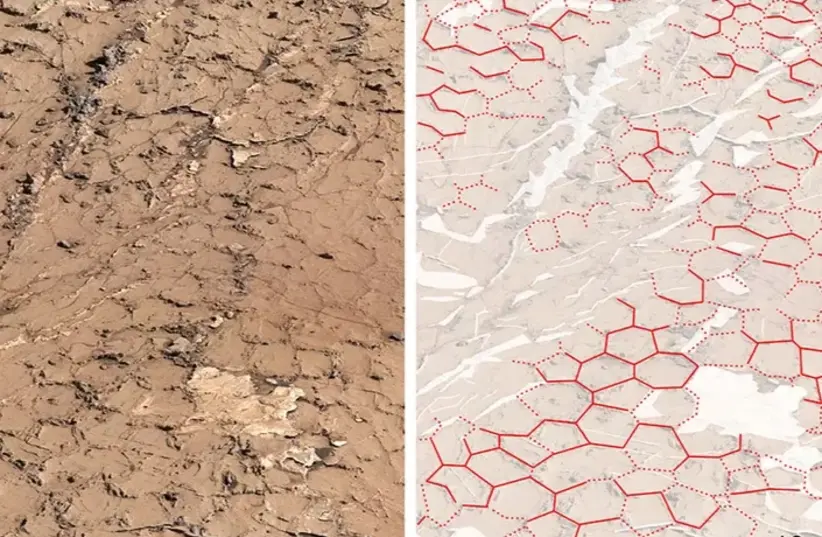
The Mars rover unmanned mission has discovered unique mud formations stereotypical of wet and dry spells over millions of years on the otherwise dry and cold Mars landscape which may have created the conditions necessary for life, according to a recent study titled ‘Sustained wet-dry cycling on early Mars’ was released in the peer-reviewed journal Nature on August 9, 2023.
The hexagonal patterns discovered are formed when an area has extended wet seasons followed by extended dry ones.
It has been known for a while that Mars contains the dried vestiges of rivers, lakes, and even seas as the study noted, “The presence of perennially wet surface environments on early Mars is well documented”.
The planet, called LP 791-18 d, is akin to both Earth and to Jupiter’s moon Io, the most volcanic world in the solar system, which NASA spacecraft Juno photographed earlier this week.
Earth’s magnetic field protects the planet’s atmosphere, which life needs to survive, by deflecting energetic particles and plasma that stream out from the sun. Finding atmospheres around planets located outside of our solar system could point to other worlds that potentially have the ability to support life.
Scientists noticed strong radio waves coming from the star YZ Ceti and the rocky exoplanet that orbits it, called YZ Ceti b, during observations using the Karl G. Jansky Very Large Array of telescopes in New Mexico. The researchers believe the radio signal was created by interactions between the planet’s magnetic field and the star.
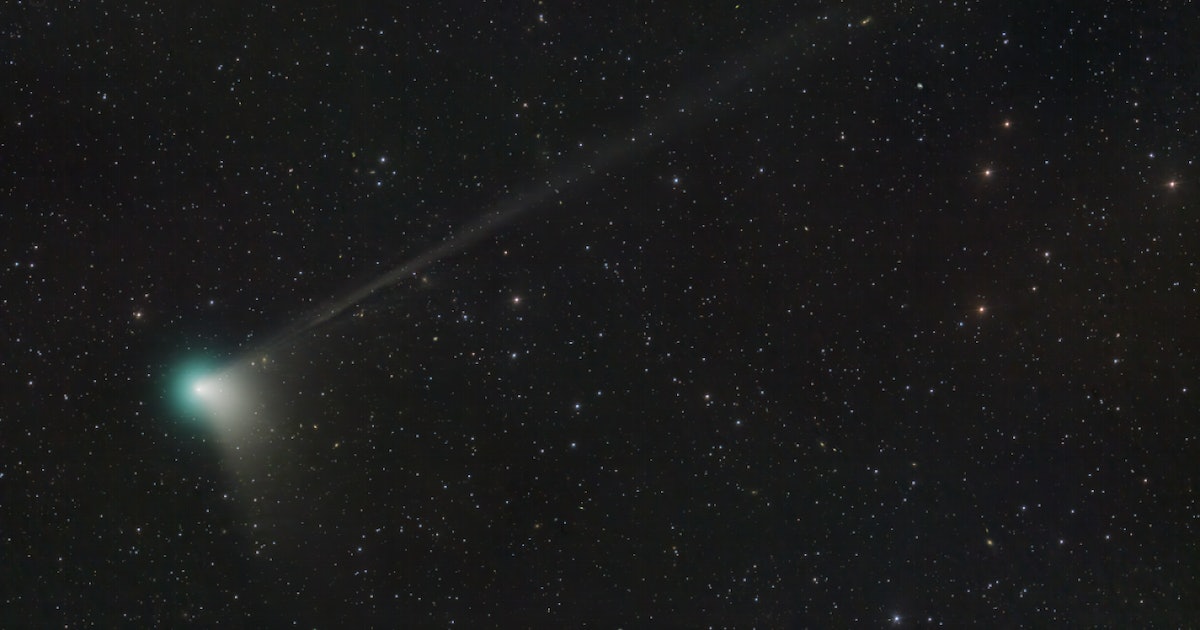
A green bright comet named C/2022 E3 (ZTF) is set to make its closest approach to Earth in two weeks, the comet was discovered in March when transiting through Jupiter’s orbit, E3 will reach perihelion on January 8, after that will be visible without glasses..
This is pretty rare, as space sites are reporting.
Here is what is known:
It was discovered in March 2022. NASA reported that the rare green comet was spotted using a wide-field survey camera at CalTech’s Zwicky Transient Facility within Jupiter’s orbit.
Since then, it has hurdled ever closer to the Sun, and as NASA noted in a post about the comet, it will reach its perigee, or closest point to us on Earth, on February 1.
From everything mainstream sources are reporting, This phenomenon has not happened in 10,000 years..
And get this!
NASA data suggests that the last time this gorgeous green goblin came this close to Earth was about 50,000 years ago..
In reality that means that the last humans to ever witness it were likely Ice Age-era Neanderthals..
And how many times was it seen prior than 50,000 years back? Did dinosaurs witness it as they roamed the earth..? Amazing stuff, this space .. and amazing what we will soon see with our naked earthly eyes.
In December 2021, a massive blast of energy hit the Earth’s atmosphere. Its source was a gamma-ray burst – one of the most powerful explosions in the universe – but not just any gamma ray burst.
One scientist said at the time that the event – named GRB 211211A – “looks unlike anything else we have seen before”.
READ MORE: Huge meteorite falls to Earth with two ‘materials never seen before on our planet’
The event was detected in December 2021 by NASA’s Neil Gehrels Swift Observatory and the Fermi Gamma-ray Space Telescope. The gamma-ray burst was significantly longer than average, which might normally suggest it had been produced by the collapse of a massive star into a supernova.
— Read on www.dailystar.co.uk/news/latest-news/earth-hit-intense-blast-energy-28680190
Hundreds of eyewitnesses across a wide region (Georgia, Indiana, Kentucky, Maryland, Michigan, North Carolina, New York, Ohio, Pennsylvania, South Carolina, Tennessee, Virginia, West Virginia and the Canadian province of Ontario)
There are plenty of planets.. plenty of galaxies.. and who knows how many multiverses, right? (Of course if they exist) ..
But we know one thing: Thus far, besides those who claim to have met anal probing aliens, we have yet to come in contact with beings from another world.
Why?
Is it possible–though unlikely–that we really are alone in this vast universe?
There is a story running about what exactly some at NASA actually thing.
Let’s explore that theory for a moment–truly consider it and not just brush it aside.
“The key to humanity successfully traversing such a universal filter is… identifying those attributes in ourselves and neutralizing them in advance,” JPL astrophysicist Jonathan Jiang and his coauthors wrote in a new study that appeared online on Oct. 23 and has not yet been peer-reviewed.
Not everyone in the sciences buys the idea of the Great Filter. “It feels overly deterministic, as if the Great Filter is a physical law or a single looming force that confronts every rising technological civilization,” Wade Roush, a science lecturer and author of Extraterrestrials, told The Daily Beast. “We have no direct evidence of such a force.”
And more..
To understand the Great Filter, Jiang and his coauthors turned a mirror on humanity. Whatever seems likeliest to kill us might also pose an existential threat to intelligent life on other planets, they proposed. They drew up a short list of the biggest threats to the human species, all but one of which are entirely our own fault.
Sure, an asteroid might hit Earth with enough force to kill pretty much everything on the planet. That’s not necessarily something we can prevent. But the other civilization-killers the JPL team think are likely are also self-inflicted. Nuclear war.Pandemic. Climate change. Runaway artificial intelligence.
It is a lot of science and a lot of research that goes into a theory–including this one. It also makes some sense, right?
So often, those stars we see in the night sky may be long gone. Their light just takes a bit to extinguish from our vision.. And life itself? Maybe gone, too. Maybe we are just.. alone.
That is immensely strange to consider–the prospect that we are just about. This universe, filled with rolling asteroids and comets and maybe water, and we are just it?
NAH.. cannot be possible, right? Way too many possibilities.
Perhaps the other possible scenario is that we are just too small, too blue, and too hidden to be found. We are in the Goldilocks zone after all–a safe space in a universe teeming with creatures that would eat and devour us if they knew we were here.
So we vote to stay alone! We vote to stay hidden.
So many WANT to find more life, DESIRE to make contact–and for too long we have just opted to think the better choice was to hide our face under the covers of the stratosphere.. Go about our earthly business. And live our lives without much pondering the existence of other life forms.
But … if they are out there, they will find us. Or we will find them–maybe just evidence of them in the end..
You know how kids get scared in the darkness of their rooms at night, and they pull their covers up real tight over their faces? Yea.. that is probably what we should do. But just be careful we don’t expose our feet in the process.. monsters always attack the feet first.
The burst of gamma-rays — the most intense form of electromagnetic radiation — was first detected by orbiting telescopes on October 9, and its afterglow is still being watched by scientists across the world.
Astrophysicist Brendan O’Connor told AFP that gamma-ray bursts that last hundreds of seconds, as occurred on Sunday, are thought to be caused by dying massive stars, greater than 30 times bigger than our Sun.